Traditional Forearm Tattoo Idea
Design Specifications
Asset Details
Artist Narrative
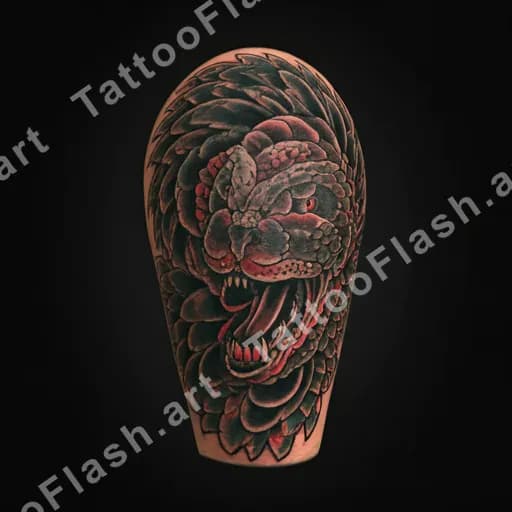
The linework structure relies on uniform bold contours with consistent tapering, while the black accent utilizes heavy saturation and controlled whip shading to establish high-contrast value separation without muddying the midtone transitions. The radial composition of the cranial anatomy aligns with the longitudinal axis of the brachioradialis and extensor carpi radialis, allowing directional shading and negative space to compress and expand naturally during forearm pronation and supination.
Placement Guidance
Traditional work typically reads best when the main silhouette stays clear at the forearm.
This concept leans on denser contrast and layered detail to stay readable after healing.
The asymmetry gives the piece more motion and helps it follow natural anatomy.
How To Use This Concept
- Bring this concept as a directional brief, not a final stencil. Let your artist adapt line weight and spacing to your skin and scale.
- Traditional references like this are strongest when the anchor shapes remain readable from a few feet away.
- If you want variants, start by adjusting size, placement, or the tattoo reference emphasis before changing the whole concept.