Learn what a flash tattoo is, how tattoo flash sheets work, and when flash makes more sense than starting with a fully custom design.
Tattooing has evolved immensely over the past few decades, introducing highly specialized techniques and complex custom drafting. Yet, despite these innovations, tattoo flash remains the absolute bedrock of the industry.
Whether you are stepping into a local parlor for the first time or booking a session with an internationally recognized artist, understanding the difference between flash and custom designs is the first critical step in your journey. Tattoo flash gives you a faster, more accessible way to choose a subject, style, and silhouette before an artist permanently applies it to your body.
What Tattoo Flash Actually Means
At its most literal, "tattoo flash" refers to pre-drawn tattoo designs. These designs are entirely finished concepts, usually illustrated on paper or cardboard, complete with solid linework, shading, and established color palettes.
Unlike a custom piece—which is drawn specifically for your unique anatomical measurements and conceptual desires after a consultation—flash is designed to be "ready-to-wear." It removes the guesswork. You see the design on the wall or in a book, and what you see is exactly what you get.
Because flash is pre-designed, it is significantly faster. There is no waiting period for the artist to draft the concept, redraw it for revisions, or calculate the geometric flow over complex musculature. The artist simply pulls the line drawing (the stencil), applies it to your chosen placement, and begins.
What a Flash Sheet Is
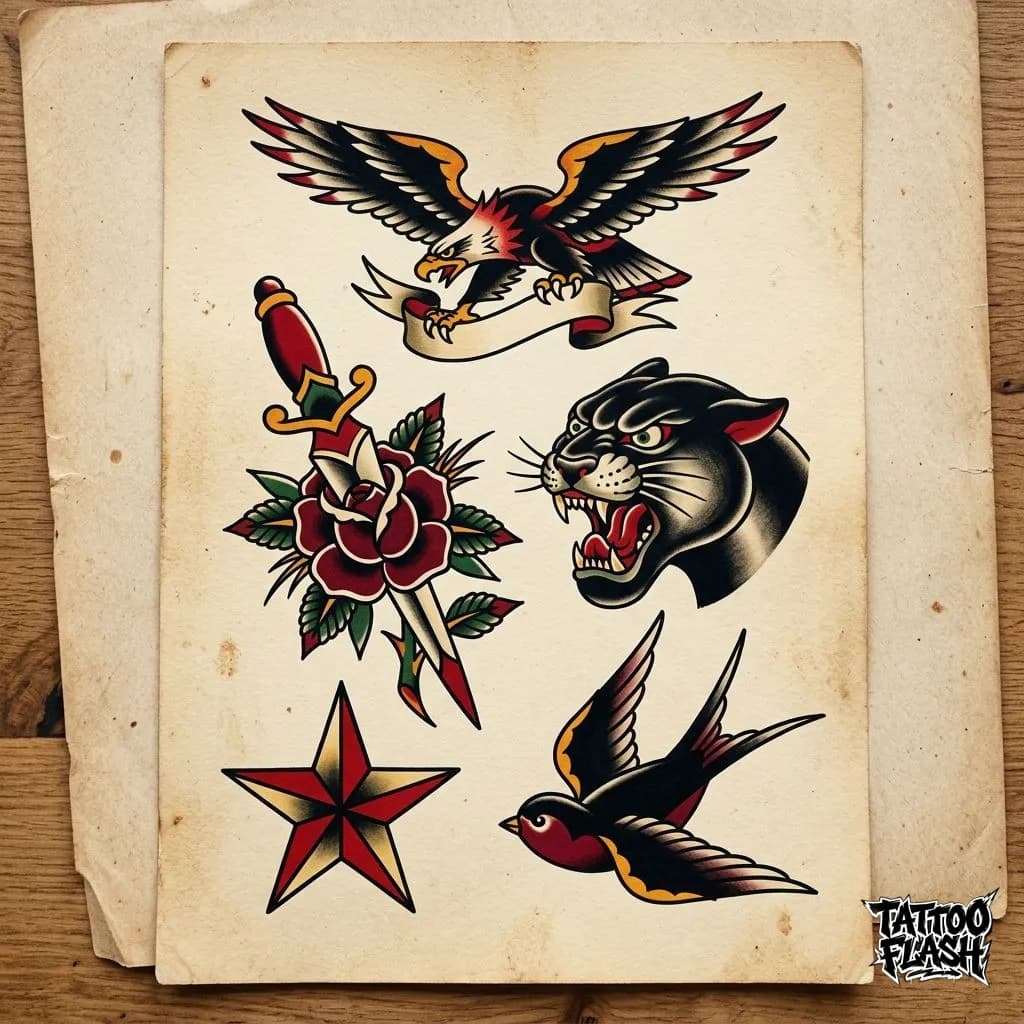
A flash sheet is the physical manifestation of tattoo flash. Historically measuring around 11x14 inches, these pages are packed with multiple individual flash designs arranged cohesively.
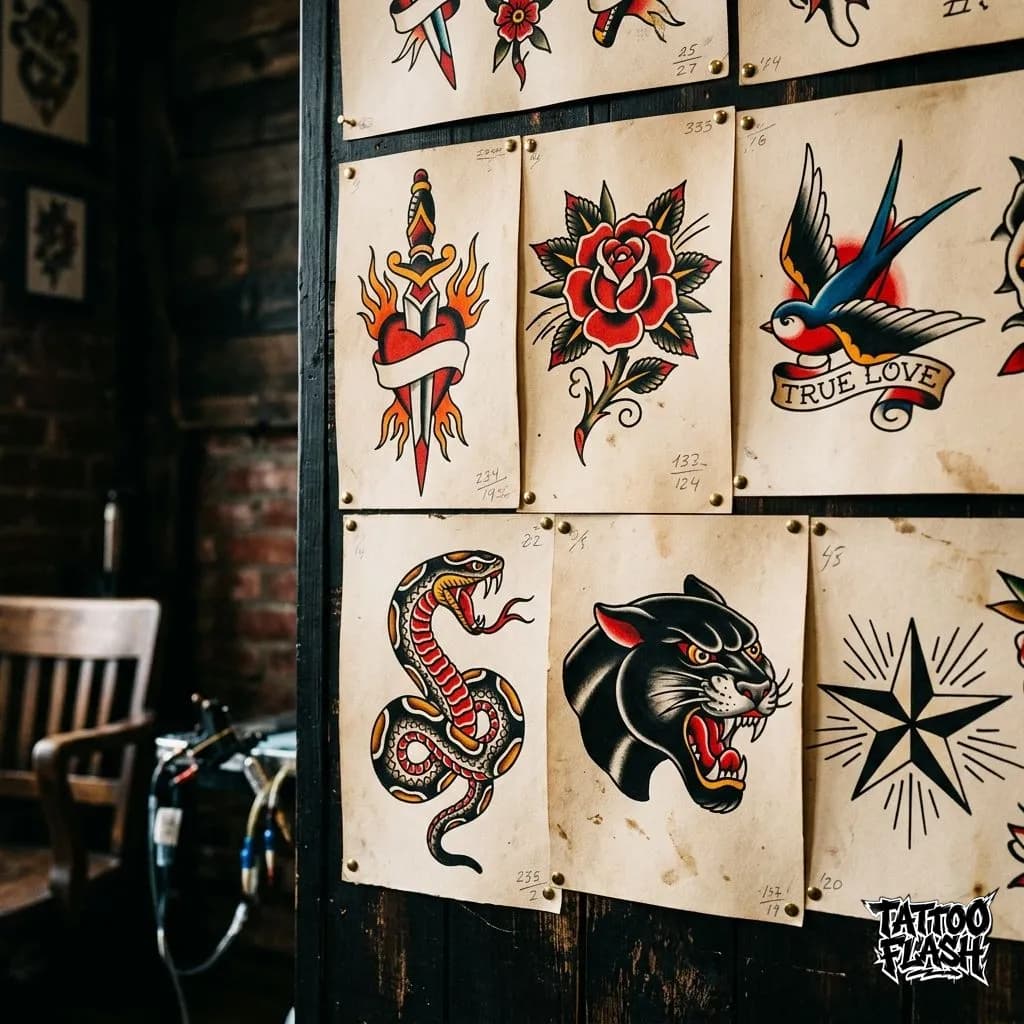
When you walk into a traditional street shop, the walls are typically covered from floor to ceiling in these sheets. This is the flash wall.
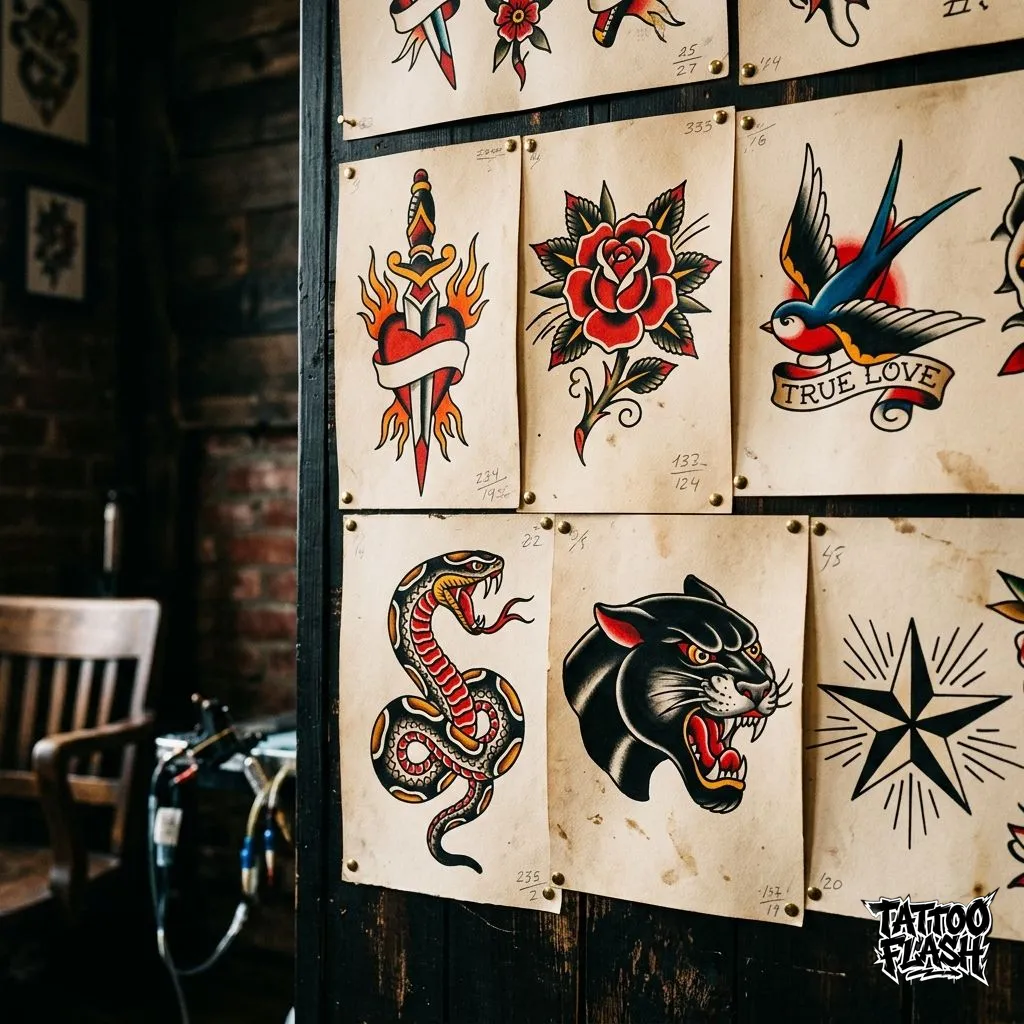 A curated wall of flash sheets in a studio. The designs are grouped efficiently, allowing clients to quickly scan hundreds of concepts for inspiration.
A single flash sheet is often tied together by a specific theme or motif family (for example, an entire sheet dedicated to nautical themes, or a sheet specifically drawing different variations of skulls and daggers). The layouts are dense but highly readable, designed to capture the eye of a client walking through the door.
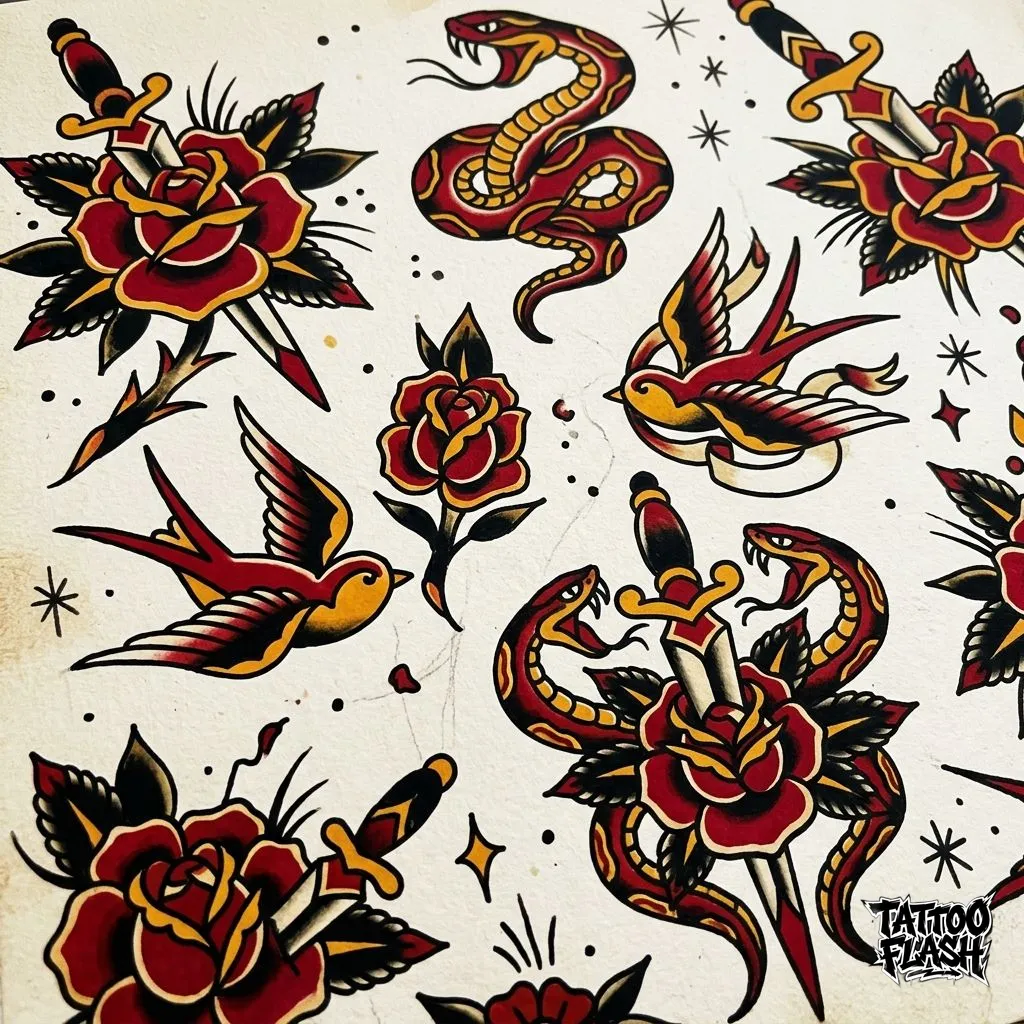 A macro view of a flash sheet. Notice how the designs utilize heavy, undeniable black outlines and deep negative space to ensure they remain legible from a distance.
Flash Tattoo vs Custom Tattoo
The primary distinction between flash and custom tattooing comes down to speed, exclusivity, and structural flow.
- Exclusivity: A traditional flash tattoo is not exclusive to you. The design lives on a public flash sheet, meaning the artist has likely tattooed that exact panther head on five other people, and will tattoo it on five more. Custom tattoos are drawn exactly once, for you alone.
- Structural Flow: A custom piece, particularly large-scale work like a full back or sleeve, is drawn to flow exclusively with your specific musculature. Flash is drawn flat. While a skilled artist will modify the stencil slightly to fit your arm or leg better, a flash design does not organically wrap and curve with your body the way a custom draft will.
- Speed and Pricing: Custom art requires a deposit for the artist's drawing time, multiple consultations, and usually commands a higher hourly rate due to the extensive preparation. Flash is immediate, and because the artist has likely executed the design before, it is faster and frequently offered at a flat, predictable rate.
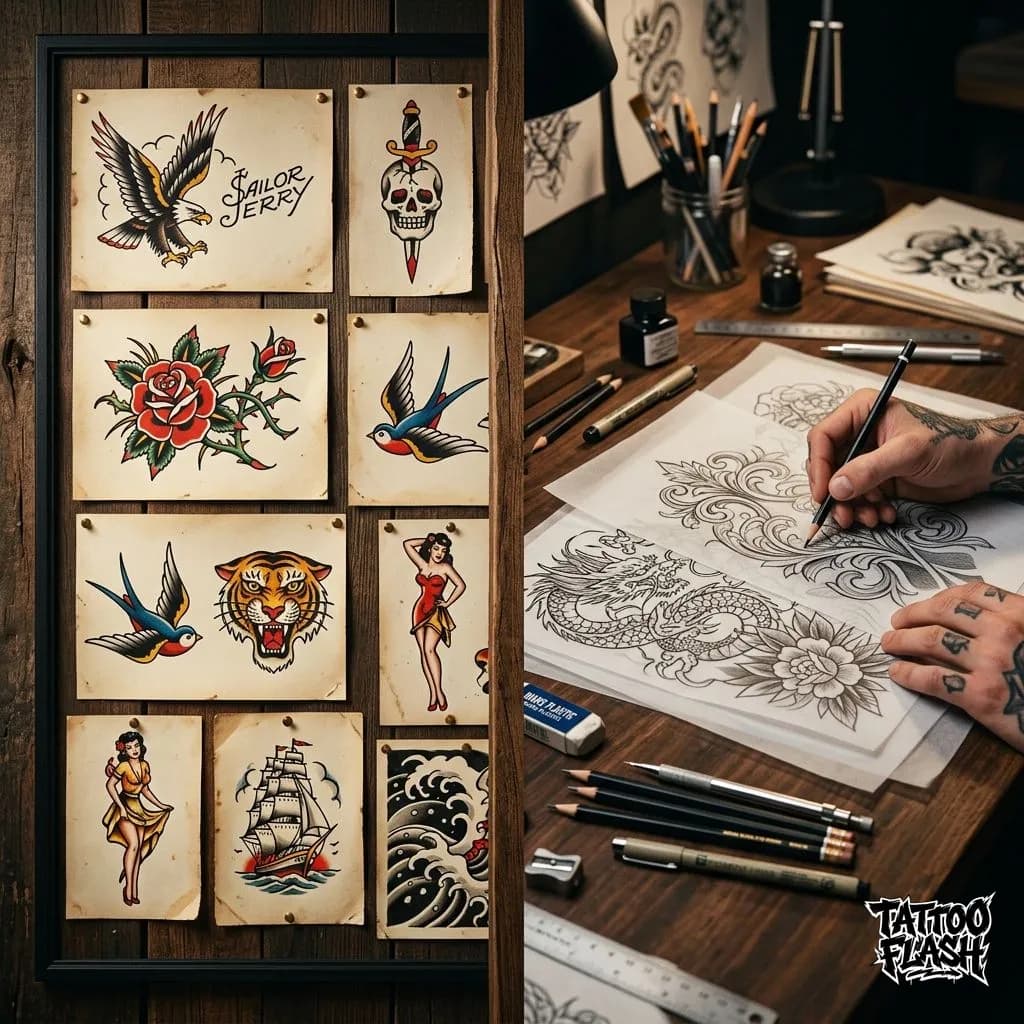
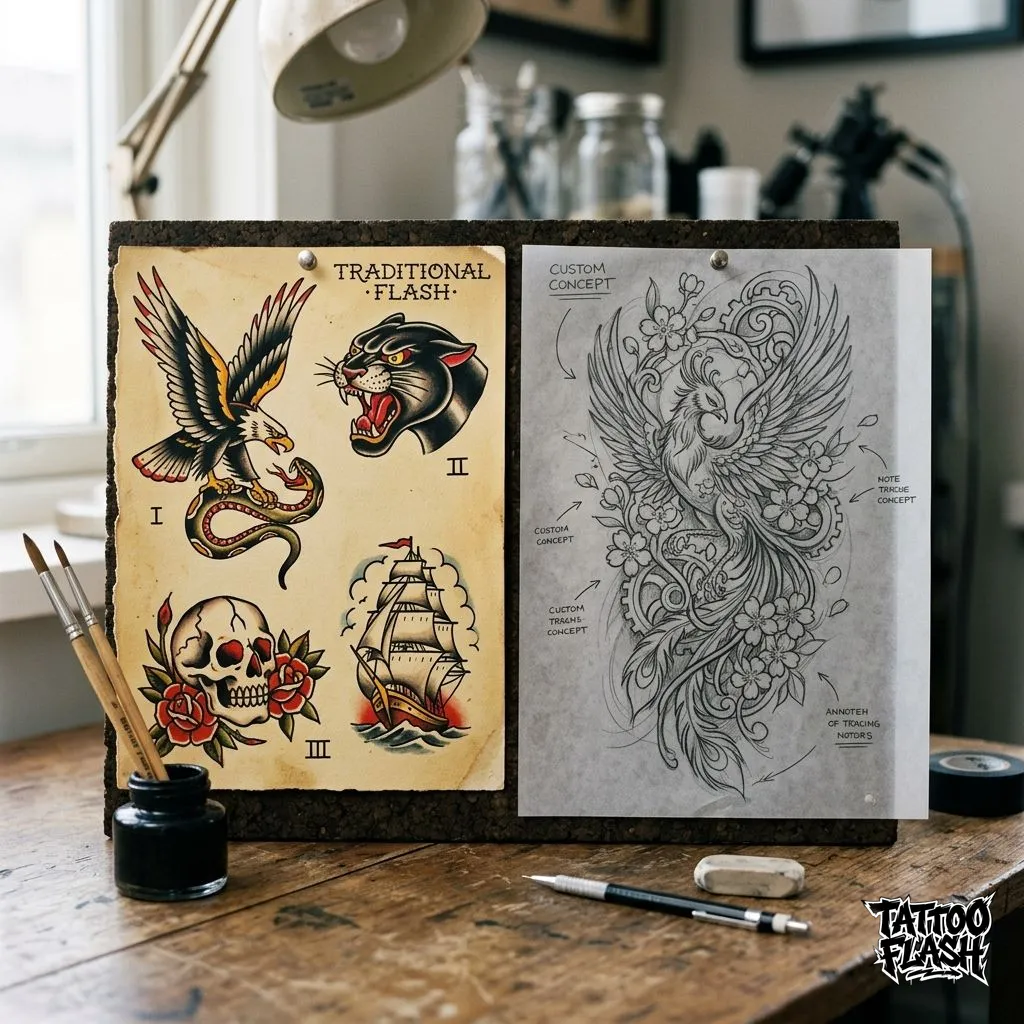 A flash sheet pinned beside a highly involved custom redraw. Custom work requires extensive planning and multiple layers of tracing paper to adjust scale and flow.
Why Traditional Tattoo Flash Matters
To understand flash, you have to understand the era of the "street shop." In the mid-20th century, particularly surrounding military bases and port towns, tattoo shops were built on extreme volume. Sailors and soldiers on brief shore leave did not have weeks to consult with an artist. They needed quick, bold, identifiable symbols—eagles, anchors, pin-up girls—executed in under an hour.
The artists of this era (like Sailor Jerry, Bert Grimm, and Amund Dietzel) created flash sheets that solved a devastatingly difficult problem: How do you create a tattoo that looks great instantly, but also survives sixty years in the sun without turning into an unrecognizable blob?
The answer was the "Bold Will Hold" methodology. They used massive black outlines to trap the color, heavy pepper shading to create dimension, and massive amounts of negative (empty) skin space to allow the ink to spread organically as the skin aged. The geometry of classic flash is literally designed for long-term survival.
How to use Flash as a Better Artist Brief
Today, you do not have to walk into a shop and point to the wall to benefit from flash. Modern clients and artists use flash as a high-fidelity visual brief.
If you want a tiger tattoo, telling an artist "I want a tiger" is a terrible brief. But handing them a piece of flash and saying, "I want a tiger with exactly this level of aggressive shading, but I want you to redraw it to wrap around my forearm," provides perfect visual clarity. You are using the flash to communicate the style and attitude, rather than just copying it outright.
Ready to explore what motifs and styles resonate with you? Start by browsing our extensive AI Tattoo Gallery. Once you find a piece of flash that captures your intent, you can use our Tattoo Generator to iterate on it until you have the perfect reference to bring to your artist.
Frequently Asked Questions
Are flash tattoos cheaper than custom tattoos? Generally, yes. Because the artist does not have to spend unpaid hours drafting, refining, and resizing a custom composition, the overall cost of a flash piece is usually lower and often presented as a flat rate.
Can I ask an artist to alter a flash design slightly? Yes, but within reason. If you want to change the color of a rose, or swap a dagger out for a sword on a flash piece, most artists are happy to accommodate. However, if you request massive structural changes, it is no longer flash—it is a custom tattoo, and will be priced accordingly.
Do modern artists still use flash sheets? Absolutely. While the "street shop" model is less common, high-end artists still produce "custom flash." These are pre-drawn designs in the artist's unique, highly specific style (like micro-realism or cybersigilism) that they want to tattoo. Once they tattoo their custom flash on one person, they often retire the design, merging the speed of flash with the exclusivity of custom work.
Don't want a generic design?
Generate your own direction, keep the symbolism, and hand your artist a cleaner starting point.
Frequently Asked Questions
Are flash tattoos cheaper than custom tattoos?
Can an artist alter a flash tattoo design?
Do artists still use flash sheets today?
Tattoo Flash Cluster
Continue the flash series
Tattoo flash ideas and flash sheets
Return to the main tattoo flash hub when you want examples, style directions, and a broader overview instead of a pure definition.
Traditional tattoo flash
Use this when you want to understand old school flash motifs, why they age well, and how classic sheets differ from broader style guides.
Flash tattoo vs custom tattoo
Read this comparison when you are deciding whether speed, price, and clarity matter more than exclusivity or deeper personalization.
About the contributor