Explore traditional tattoo flash, the classic motifs found on flash sheets, and why bold old school design rules still hold up so well.
If you have ever stepped foot inside an established tattoo shop, you have seen it: entire walls plastered with sheets of paper covered in eagles, panthers, bleeding hearts, and daggers. This is traditional tattoo flash.
While modern tattooing encompasses dozens of hyper-specific subgenres—from photo-realism to cyber-sigilism—traditional tattoo flash remains the uncompromising foundation of the craft. It is the language that built modern tattooing, and it is entirely based on a simple, ruthless design philosophy: if it doesn't look instantly recognizable from ten feet away, it isn't worth tattooing.
But what exactly makes traditional flash so enduring? Let's break down the logic of classic flash sheets and why these specific motifs refuse to go out of style.
What Makes Traditional Tattoo Flash Different
In casual conversation, people often use the terms "traditional tattoo" and "flash" interchangeably. While they overlap heavily, they are entirely different concepts.
As we discussed in our guide on What Is a Flash Tattoo?, "flash" simply refers to any pre-drawn design that is ready to be tattooed. A flash sheet can technically be drawn in any style.
Traditional tattoo flash, however, refers to flash sheets drawn specifically in the American Traditional style. This style traces its roots back to the early 1900s, popularized by pioneers like Sailor Jerry and Amund Dietzel who were tattooing sailors, soldiers, and working-class rebels.
Because early tattooing equipment was heavy and crude, and clients were on tight schedules, the artwork had to be incredibly efficient. Traditional flash is defined by its strict visual constraints:
- Bold, thick black outlines that hold the shape of the design together over decades of sun exposure and skin aging.
- A highly restricted color palette primarily consisting of solid black, bright "blood" red, vibrant yellow, and deep forest green.
- Heavy use of negative space. Traditional artists intentionally leave open patches of un-tattooed skin within the design to allow the ink to expand over time without blurring into a muddy, illegible mess.
Classic Motifs Found on Traditional Flash Sheets
When browsing traditional flash, you will notice the exact same subjects repeated endlessly. This is not a lack of imagination; these motifs are chosen because they are universally understood symbols that translate perfectly onto human skin.
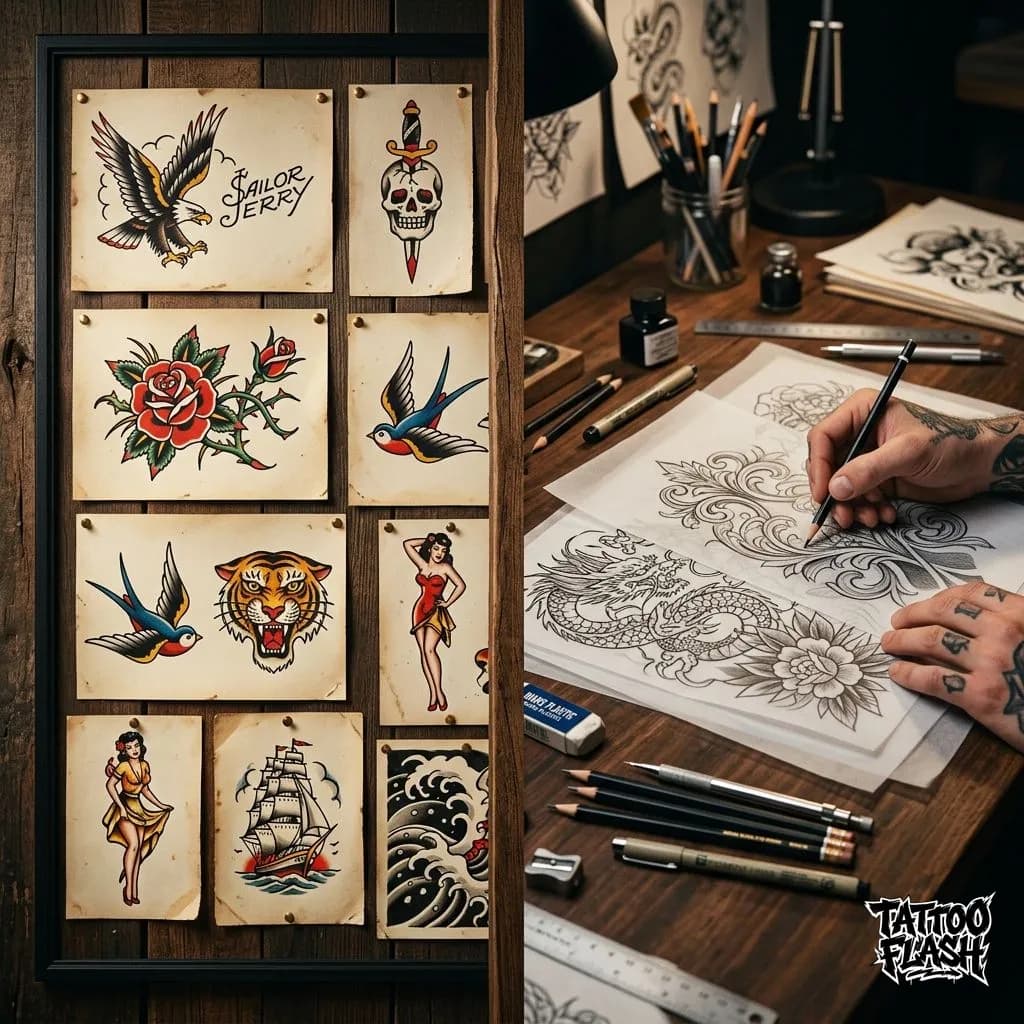
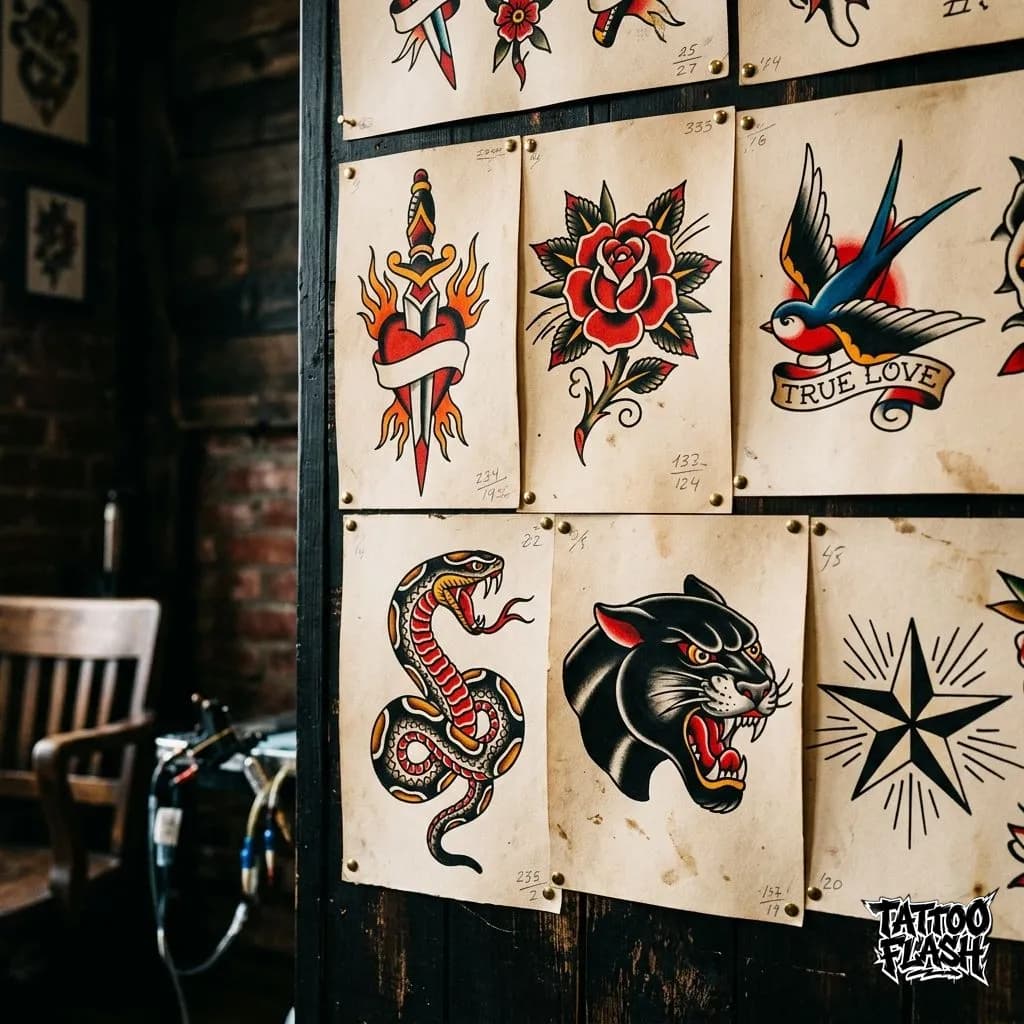
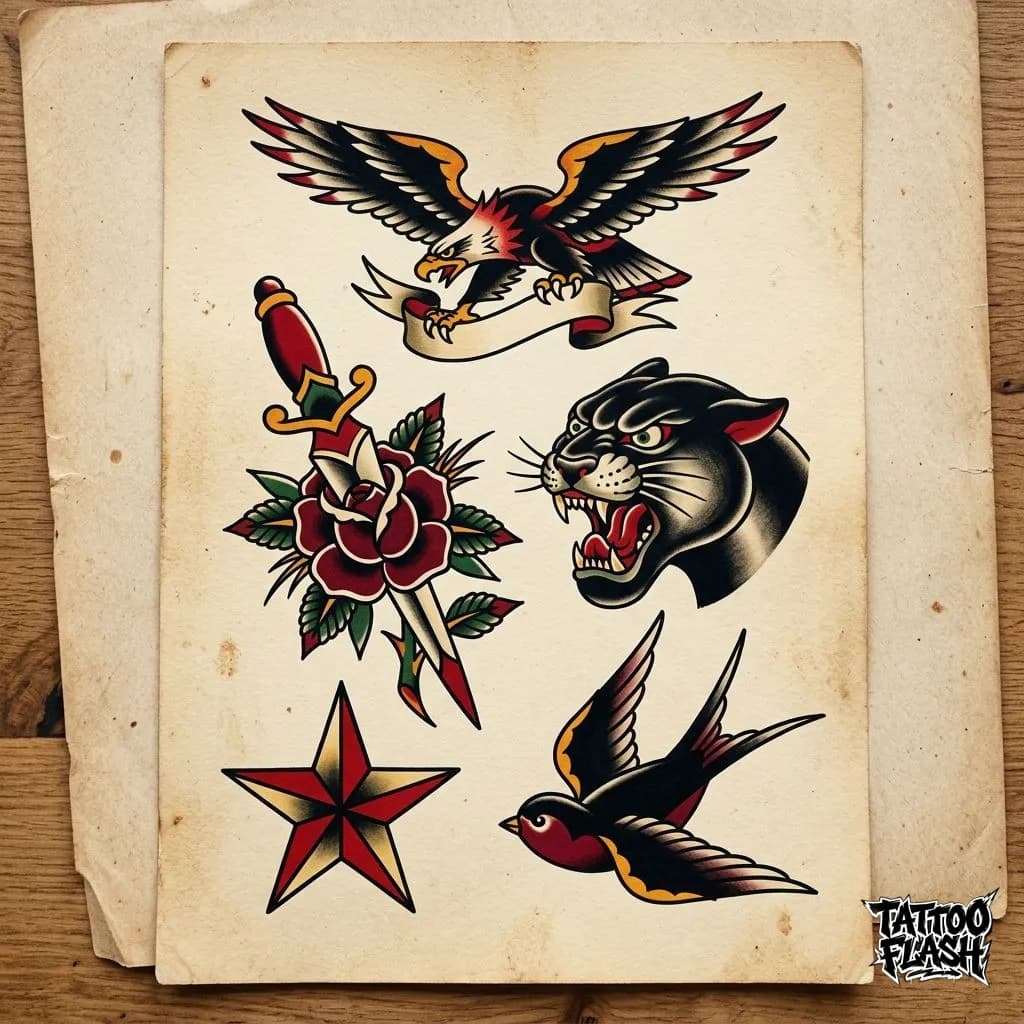
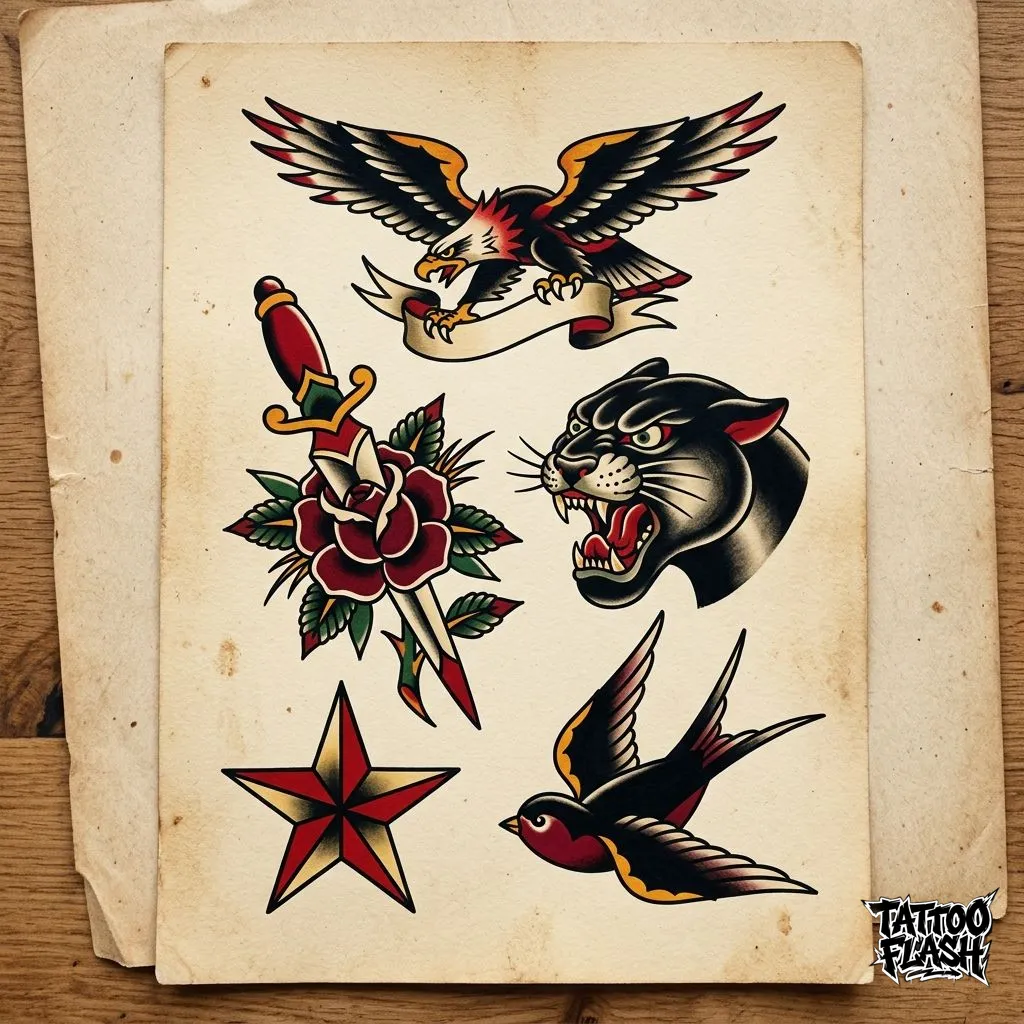 A classic traditional flash sheet compilation. Notice how every design utilizes the exact same limited color palette to create visual cohesion.
Some of the most foundational motifs include:
- The Dagger: A symbol of betrayal, heartbreak, or protection. The dagger is heavily favored because its long, straight geometry perfectly accentuates the natural lines of the forearm or shin. Read our deep dive into dagger tattoo meanings for more context.
- The Swallow: Popularized by sailors as a marker of distance traveled (traditionally 5,000 nautical miles per bird) and the promise of a safe return home.
- The Black Panther: The ultimate symbol of ferocity and independence. The "crawling panther" was specifically designed to utilize large areas of heavy black ink, which was practically useful for covering up older, poorly executed tattoos.
- The Rose: Timeless beauty and love. The traditional rose is arguably the most recognizable motif in western tattooing, utilizing sweeping arcs that fit flawlessly on almost any body part.
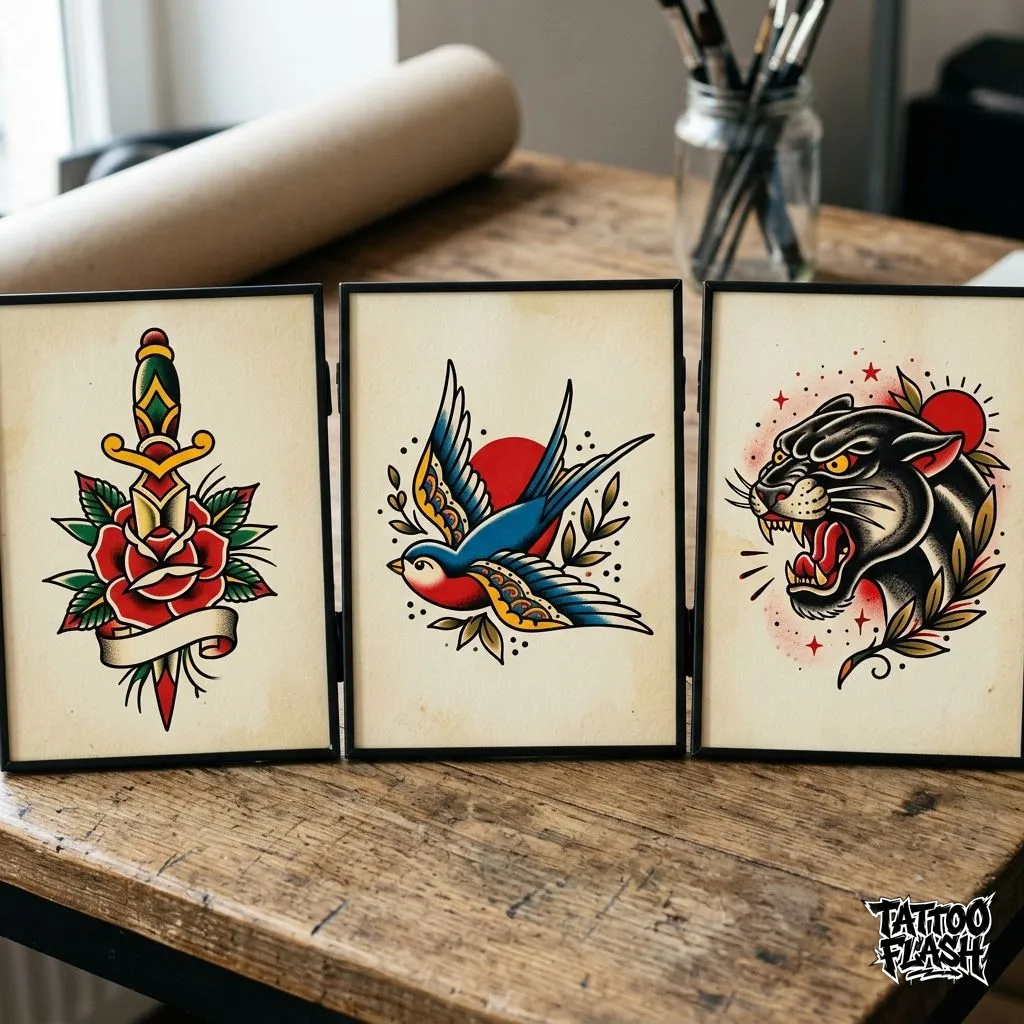 Three staple traditional motifs. The bold outlines and limited palettes ensure these designs will outlast the wearer.
Why Bold Outlines and Simple Color Blocks Age Well
The golden rule of traditional tattoo flash is: "Bold Will Hold."
Human skin is not a static canvas; it is a living organ. Over decades, ink particles suspended in the dermis layer are slowly broken down by white blood cells. This causes all tattoos, regardless of style, to fade and expand slightly.
Highly detailed, hyper-realistic tattoos with no black outlines run the risk of blurring together after ten years. Traditional flash anticipates this biological reality. The thick black outlines act like literal retaining walls for the color, keeping the structure of the panther or eagle entirely intact even as the edges inevitably soften. This is why a traditional tattoo done fifty years ago is usually still instantly recognizable today.
When to Choose Traditional Flash Over a Custom Redraw
When should you choose a design straight off a traditional flash sheet instead of asking an artist to create a custom piece?
Choose traditional flash if:
- You value history and culture over absolute uniqueness. Wearing a classic piece of flash connects you directly to a century of tattoo lineage.
- You want guarantees. Flash designs have been tattooed tens of thousands of times. They are proven to work, proven to fit, and proven to heal beautifully.
- You want to collect. Many enthusiasts treat traditional flash like stamps; they want to "collect" a classic piece from multiple respected artists around the world, completely filling their arms or legs.
If you have a hyper-specific personal vision that requires merging three different unrelated elements, you will likely need a custom draft rather than finding it on a flash sheet.
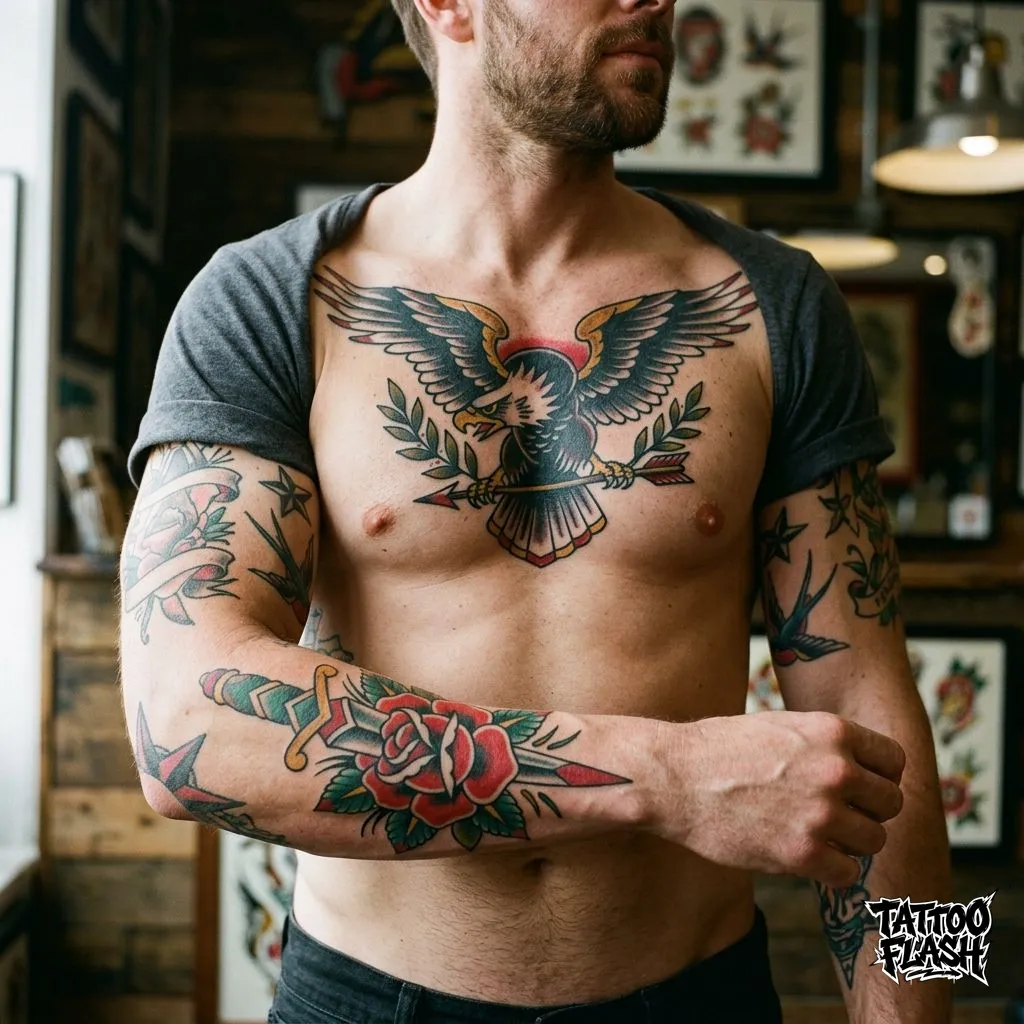 Traditional tattoos placed in the real world. The classic eagle flawlessly holds the center of the chest, while the dagger and rose fit the vertical space of the forearm.
Best Placements for Traditional Flash-Inspired Pieces
The beauty of traditional flash is its modularity. Because each piece is self-contained with a hard outline, you can place them almost anywhere. However, certain motifs naturally thrive in certain biological spaces:
- The Chest: This is prime real estate for massive, symmetrical traditional pieces. The eagle, the pharaoh's horses, or the clipper ship are historically designed to stretch powerfully across the pectorals.
- The Forearm and Calf: Long, vertical spaces demand vertical art. Daggers, torches, standard roses, and climbing panthers naturally follow the bones of the limbs.
- The Hand and Neck: As you run out of prime torso space, smaller traditional motifs like the swallow, the nautical star, or the spider web are perfectly scaled to fit the dense, highly visible curves of the extremities.
If you are drawn to the timeless aesthetic of "Bold Will Hold," start by browsing our curated AI Tattoo Gallery directly filtered for traditional pieces. When you find a piece of flash that resonates, drop it into the Tattoo Generator to explore variations and colors before bringing it to your local traditional specialist.
Don't want a generic design?
Generate your own direction, keep the symbolism, and hand your artist a cleaner starting point.
Frequently Asked Questions
Why does traditional tattoo flash age so well?
Is traditional tattoo flash the same as neo-traditional?
Which motifs appear most often on traditional flash sheets?
Tattoo Flash Cluster
Continue the flash series
Tattoo flash ideas and flash sheets
Go back to the hub to compare traditional flash with other flash directions, overview pages, and example-led navigation.
What is a flash tattoo?
Start with the exact definition page if you want the cleanest explanation of flash sheets, pre-drawn designs, and how flash differs from custom work.
Flash tattoo vs custom tattoo
Read this comparison when you are deciding whether speed, price, and clarity matter more than exclusivity or deeper personalization.
About the contributor