Compare flash tattoos and custom tattoos by speed, personalization, design clarity, and artist workflow so you can choose the right starting point.
You have made the decision to get a tattoo. You have the budget, you have conceptually narrowed down what you want, and you are ready to book. The next major fork in the road is deciding how that design will actually be created.
Should you pull a pre-drawn design directly from an artist's portfolio (a flash tattoo), or should you commission them to draw something entirely unique for your specific body (a custom tattoo)?
Flash gives you speed and design clarity. Custom gives you absolute control. The right choice depends entirely on your motif, the placement on your body, and how specific your idea naturally is.
When Flash is the Smarter Starting Point
As we established in What Is a Flash Tattoo?, flash is not a compromise. It is a highly optimized, proven template. You should heavily consider choosing flash if:
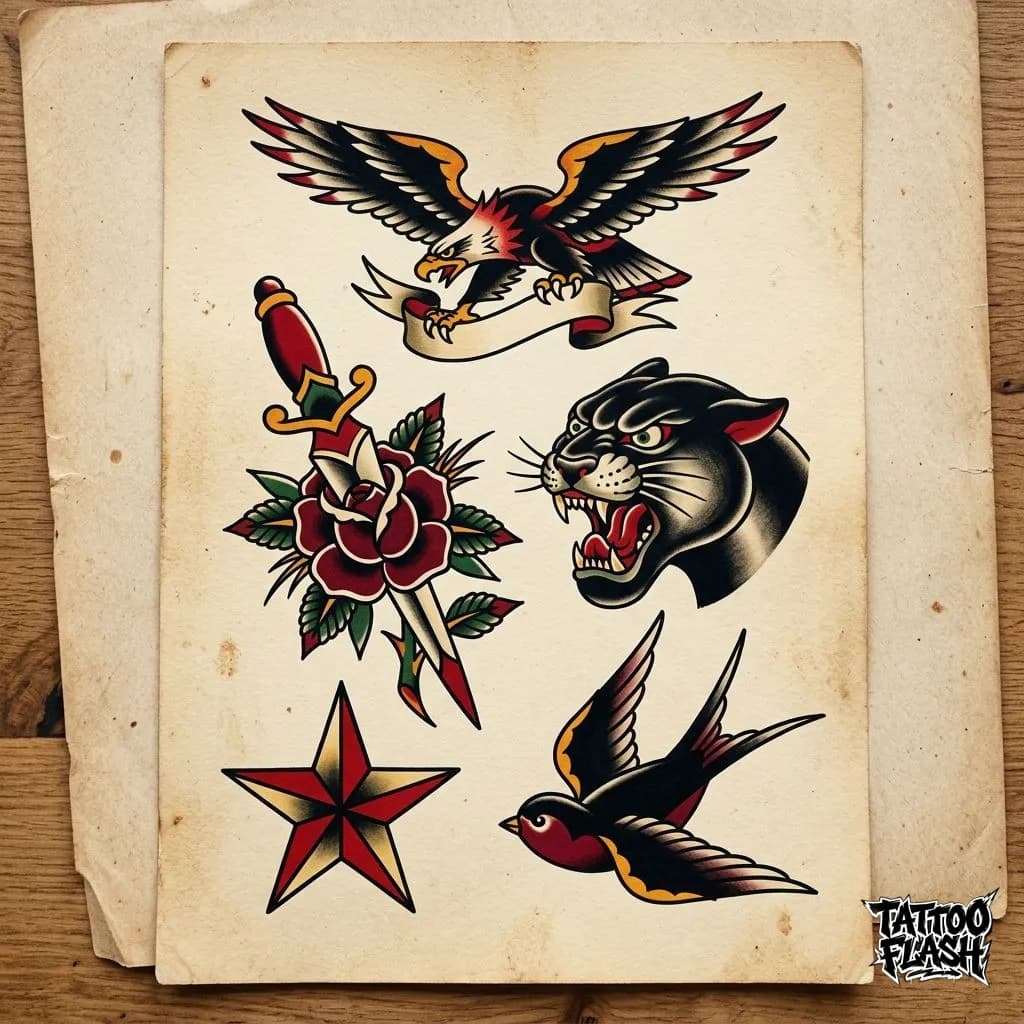
- You Love Traditional Styles: If you are looking for an American Traditional panther, a neo-traditional rose, or a classic swallow, passing on flash is highly unnecessary. These motifs were optimized into flash decades ago. Modifying them too heavily often breaks the specific proportions that make the style work in the first place.
- You Value Fast, Flat Pricing: Because flash is pre-drawn and the artist has likely tattooed it before, you skip the consultation and drawing fees. Many flash pieces are priced at a flat "piece rate" rather than an hourly rate.
- You Want Guarantee Over Exclusivity: A piece of flash on a studio wall means that the exact line weight and shading gradients are already calculated. You can see exactly what the final piece will look like before the stencil even touches your skin.
When Custom Work is Worth the Extra Drafting
While flash is efficient, there are absolute limitations to picking pre-drawn art. You should move to a custom project if:
- You Have a Highly Specific Concept: If you want a wolf howling, flash is fine. If you want a wolf howling in front of a specific mountain range, incorporating a pocket watch stopped at 3:15, and layered with specific floral elements from your home state—you need a custom piece.
- You Are Working Around Existing Tattoos: If you are trying to fill remaining awkward gaps in a sleeve (often called "gap-fillers"), standard flash will rarely fit the odd organic spaces left behind. A custom piece can be drawn specifically to nestle securely between two existing tattoos.
- You Need Flow Over Complex Anatomy: If you are tattooing highly mobile, curved topography like the knee, the clavicle, or wrapping down the ribs, sticking flat flash on it can warp the image unpleasantly. Custom work allows the artist to draw the reference directly onto your body using markers to ensure the design stretches gracefully with your natural movements.
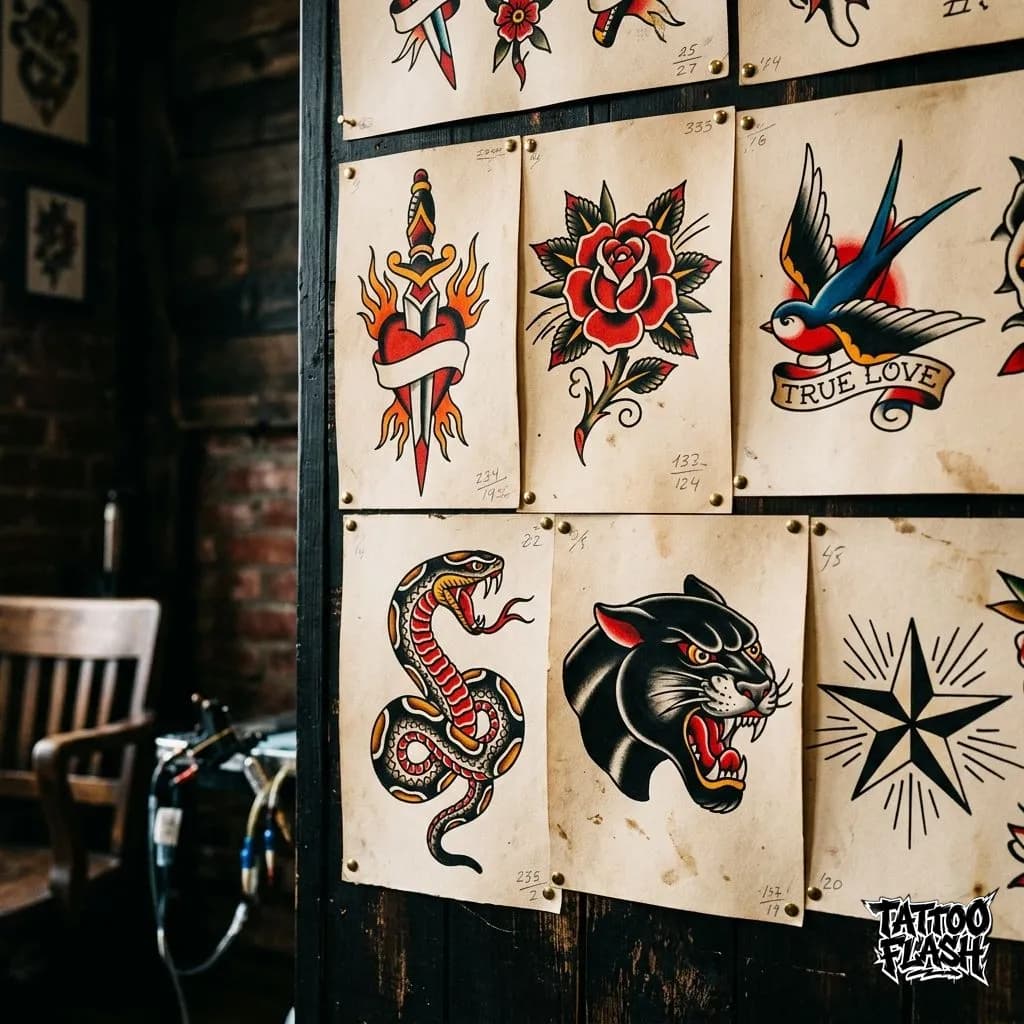
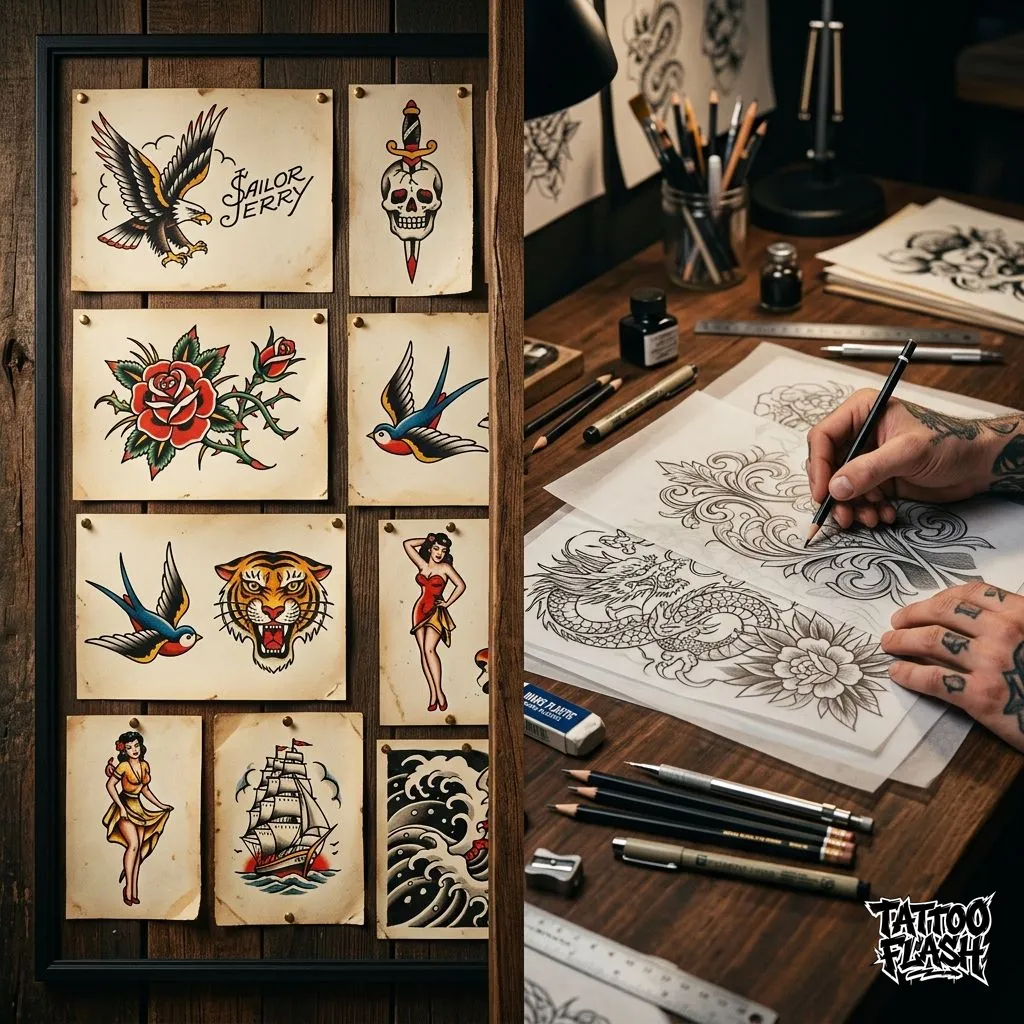 A classic split. Selecting pre-organized flash takes seconds, while drafting a custom piece requires extensive sketching, tracing, and client revisions.
Tradeoffs in Speed, Control, and Readability
The tension between flash and custom tattooing usually balances on three metrics:
- Speed: Getting a custom sleeve drawn can take months of back-and-forth communication, measuring, and waiting for the artist's availability. Flash allows you to walk into a shop randomly on a Tuesday and walk out two hours later fully inked.
- Control: With flash, you get zero input on the underlying structure of the piece. You can change colors or slightly alter the size, but you cannot change the foundation. Custom work gives you the ability to dictate exactly what elements exist and how they are emphasized.
- Readability: Many clients mistakenly believe that packing more personal meaning into a custom tattoo makes it better. Often, trying to fit eight different metaphorical concepts into a single drawing results in a cluttered, visually messy tattoo. Flash forces extreme readability because the artist designed it to look powerful, not to tell a biographical story.
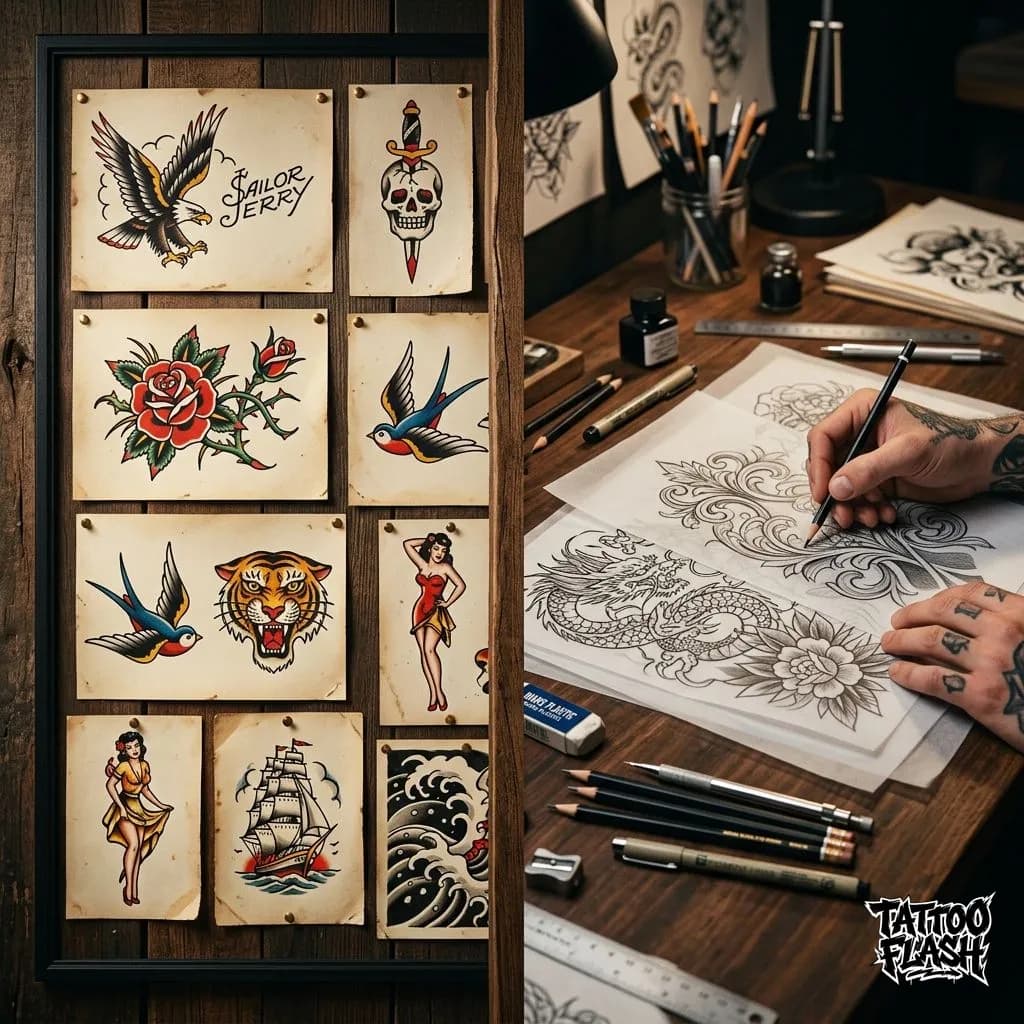
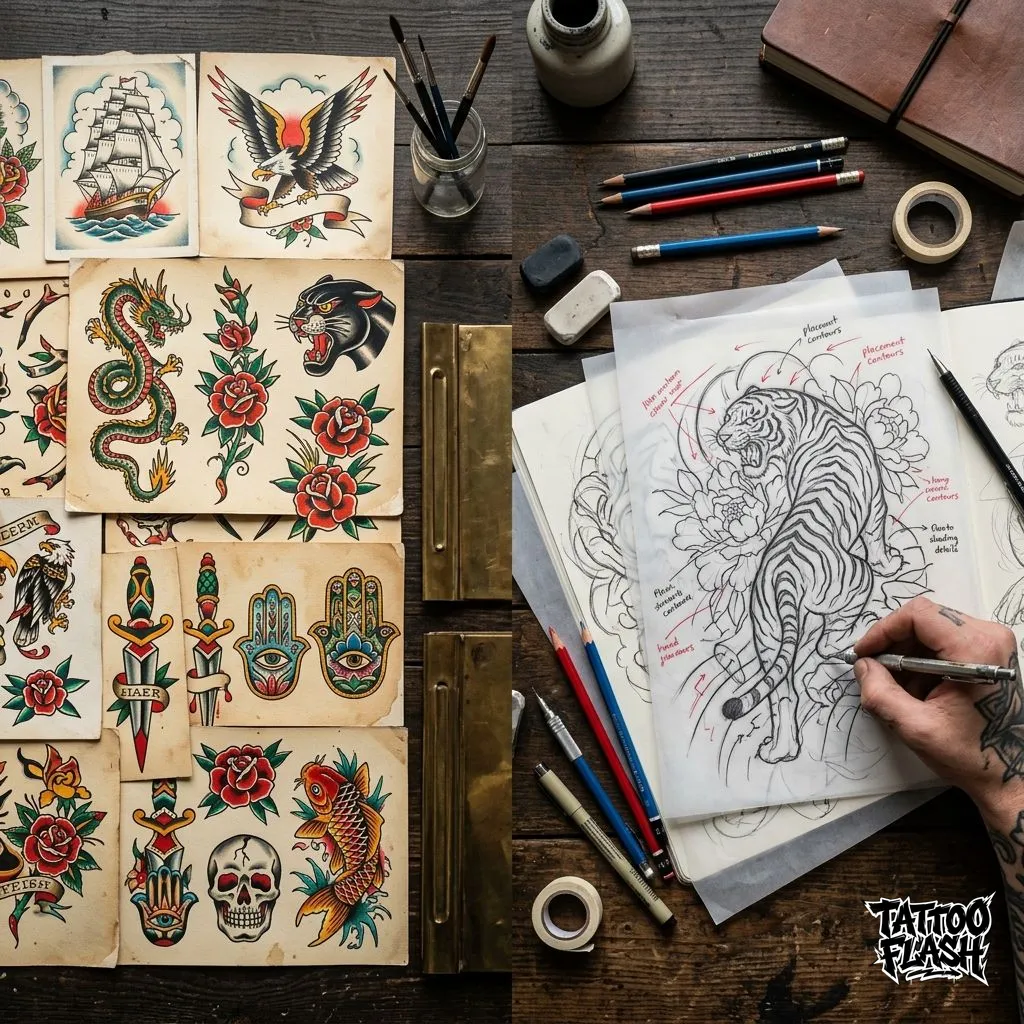 The workflow difference. Notice how custom work heavily relies on iterative tracing paper to adjust sizing against client measurements.
Placement and Motif Questions That Change the Answer
Your chosen body placement can force your hand in this decision.
Large, flat surfaces like the chest, the front of the thigh, and the outer bicep are incredibly forgiving. You can take almost any 4x4 inch piece of flash and stick it cleanly onto these spots.
However, areas like the collarbone, the sternum, or behind the ear are anatomically distinct on every human. The angle of a collarbone varies wildly, meaning a piece of "sternum flash" might not sit evenly on your actual ribs. For these high-curvature areas, transitioning a flash idea into a custom fitting is usually the safest path.
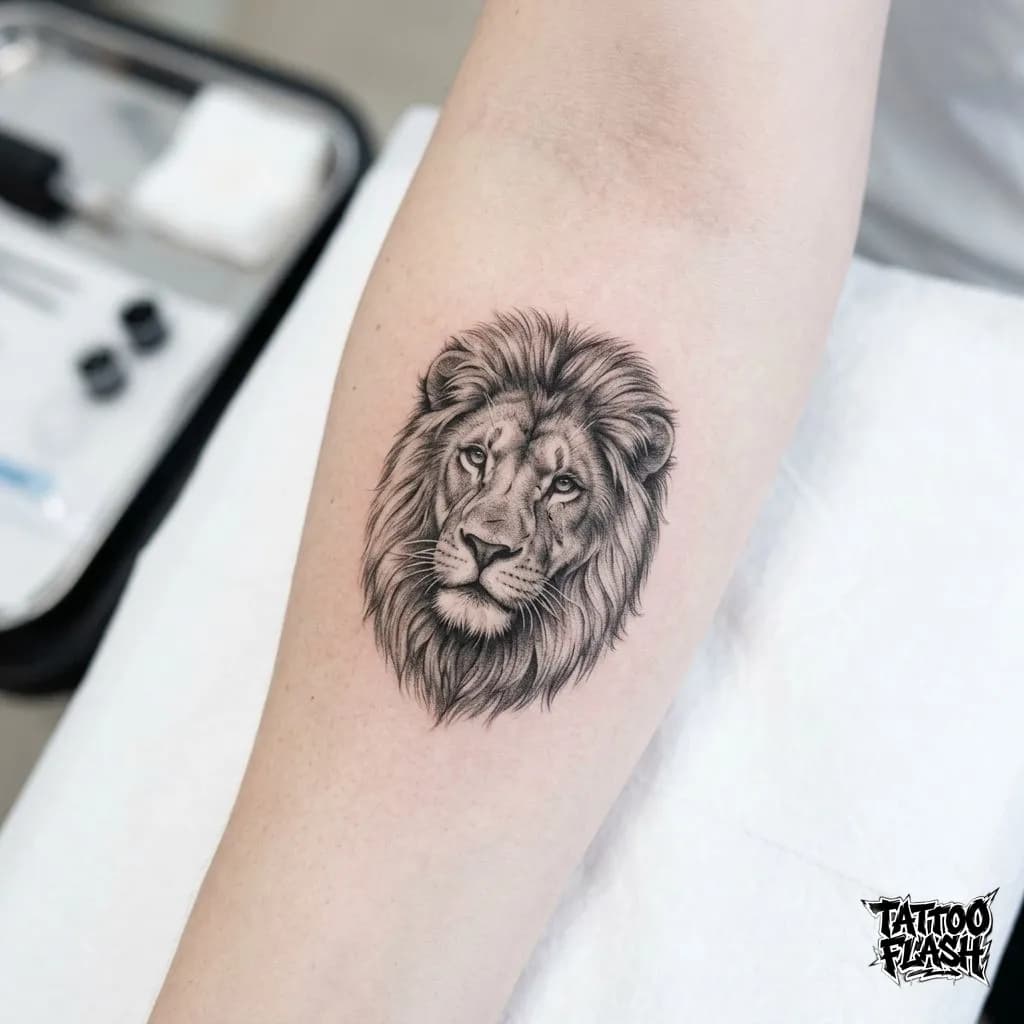
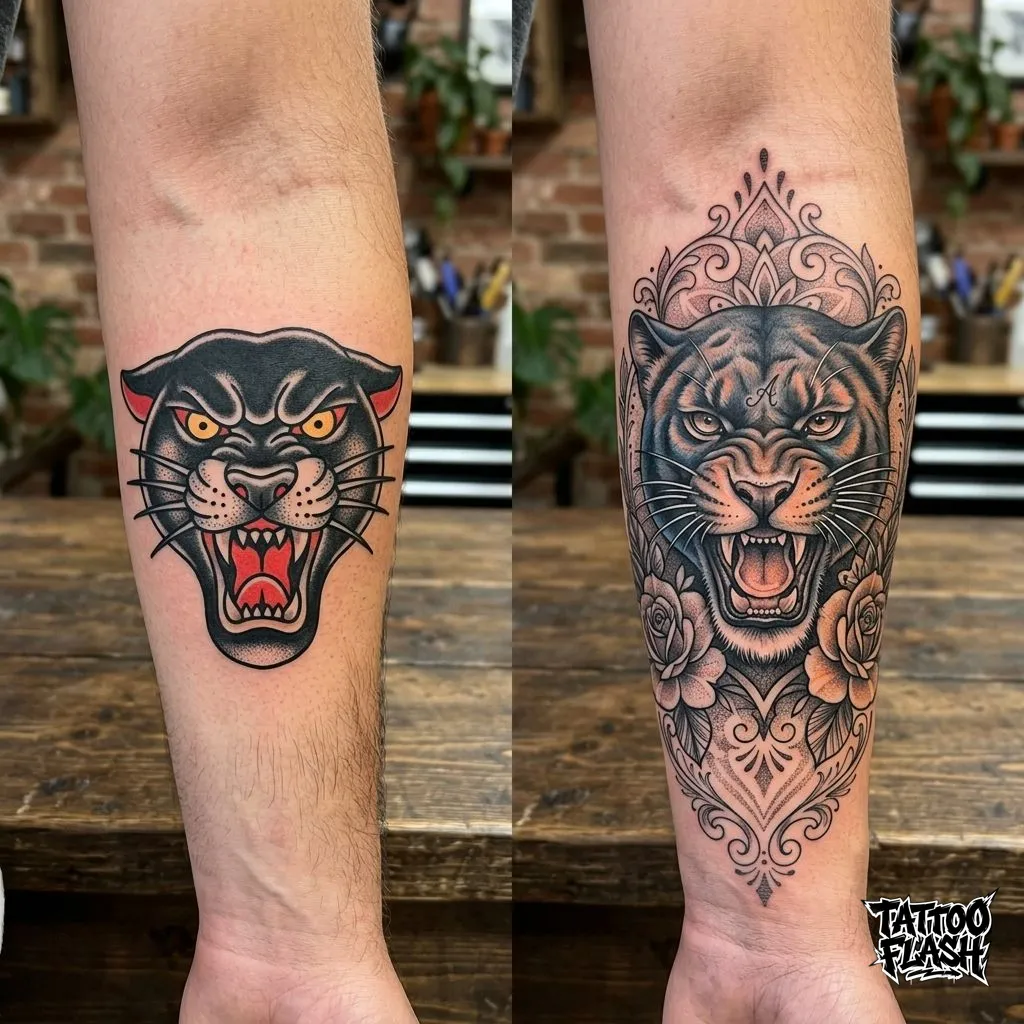 The same core motif (a panther head) executed two different ways. The left utilizes standard flash proportions. The right shows a custom adaptation utilizing intricate, personalized framing and custom shading gradients.
A Simple Decision Framework Before You Book or Generate
If you are still struggling to decide, follow this decision tree:
- Do you care if someone else in the world has your exact tattoo? If yes, you must go custom. If no, flash is viable.
- Is the tattoo meant to represent a highly specific life event or multiple combined subjects? If yes, go custom. If it is purely an aesthetic choice (e.g., "I just think skulls look cool"), flash is usually better.
- Are you trying to wrap a design around a highly curved body part? Custom work ensures better geometric flow.
Very often, clients land in a hybrid workflow. They find a piece of flash they love, and they use it as an airtight visual brief for their artist to create a custom variation.
If you are exploring this hybrid route, start by browsing our Tattoo Gallery to find concepts you lean toward, and then use our Tattoo Generator to combine your ideas into a unified reference before your consultation.
Don't want a generic design?
Generate your own direction, keep the symbolism, and hand your artist a cleaner starting point.
Frequently Asked Questions
Should I choose flash or custom for my first tattoo?
Can I start from flash and still make the final tattoo personal?
When is a custom tattoo clearly the better option?
Tattoo Flash Cluster
Continue the flash series
Tattoo flash ideas and flash sheets
Use the tattoo flash hub when you want to browse examples and sheets before deciding whether to stay with flash or move into custom drafting.
What is a flash tattoo?
Start with the exact definition page if you want the cleanest explanation of flash sheets, pre-drawn designs, and how flash differs from custom work.
Traditional tattoo flash
Use this when you want to understand old school flash motifs, why they age well, and how classic sheets differ from broader style guides.
About the contributor